

Defense Sector Eyes US$ 54.76 Billion Underwater Warfare Market by 2035 as Undersea Threats Intensify
Underwater Warfare Market
Autonomous vehicles, next-gen sonar, and growing defense budgets are propelling steady growth across the global underwater warfare market.
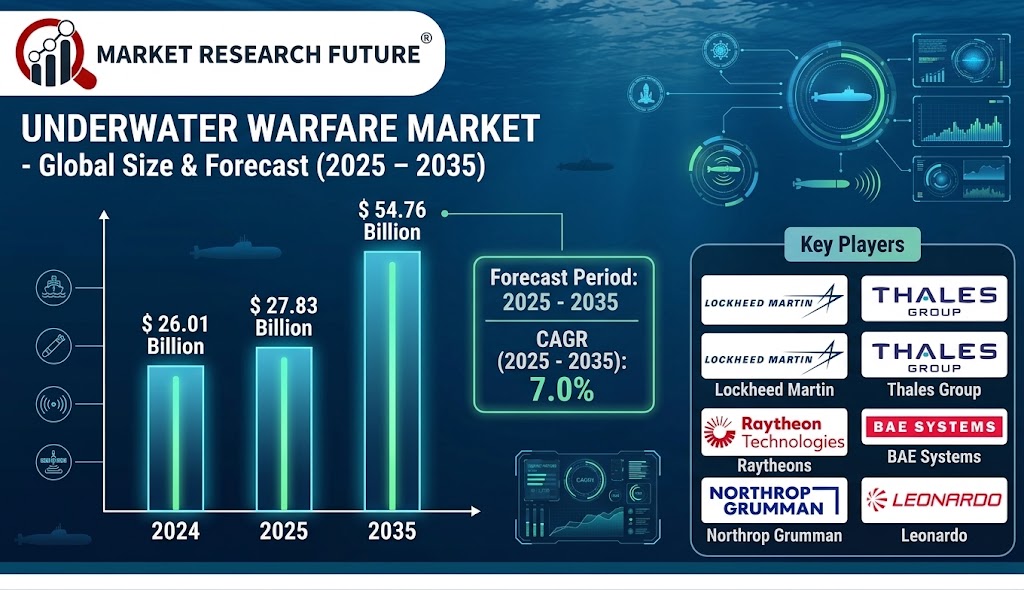
NEW YORK, NY, UNITED STATES, September 1, 2026 /EINPresswire.com/ -- The global underwater warfare market is entering a pivotal decade of expansion, with new industry analysis projecting the sector will grow from an estimated US$ 26.01 billion in 2024 to roughly US$ 27.83 billion in 2025, before climbing to approximately US$ 54.76 billion by 2035. That trajectory implies a compound annual growth rate near 7.0% across the 2025–2035 forecast window, underscoring how quickly naval powers are moving to modernize their subsurface capabilities in response to shifting geopolitical realities.The underwater warfare market encompasses the full spectrum of technologies nations deploy to detect, deter, and, when necessary, engage adversaries beneath the waves — from unmanned underwater vehicles and advanced sonar arrays to electronic warfare suites, torpedoes and other weapons systems, and the secure communications networks that tie submarine, surface, and aerial assets together. As maritime security concerns intensify across multiple regions simultaneously, defense ministries are treating undersea dominance not as a niche capability but as a central pillar of national security strategy.
A Market Driven by Technology, Tension, and Budget Growth:
Several converging forces are propelling the underwater warfare sector forward. Chief among them is the steady rise in global defense spending, with total worldwide military outlays widely expected to approach the USD 2 trillion mark within the next couple of years. A meaningful share of that spending is being redirected toward undersea capabilities, as governments in North America, Europe, and Asia-Pacific alike prioritize submarines, underwater drones, and anti-submarine warfare systems as strategic necessities rather than optional upgrades.
Request for Free Sample of Report: https://www.marketresearchfuture.com/reports/underwater-warfare-market-21884
Technological innovation is the second major growth engine. The integration of artificial intelligence and machine learning into underwater platforms is transforming how navies gather intelligence, process sonar returns, and make split-second tactical decisions. Autonomous underwater vehicles, once considered experimental, are now being fielded for reconnaissance, mine countermeasures, and surveillance missions that previously required manned platforms — reducing operational risk while extending the reach of naval forces into contested or hard-to-access waters.
Escalating geopolitical tensions form a third pillar of demand. Territorial disputes, contested shipping lanes, and heightened concern over adversarial submarine activity are pushing coastal and maritime nations to accelerate procurement of detection and deterrence technologies. At the same time, the market is being shaped by a less obvious but growing trend: environmental stewardship. Navies and shipbuilders are increasingly investing in quieter propulsion systems and more sustainable manufacturing practices, driven by a recognition that undersea military activity carries ecological consequences that can no longer be ignored.
International collaboration is also reshaping the competitive landscape. NATO members and allied nations are expanding joint exercises, technology-sharing agreements, and co-development programs, reflecting a broader understanding that undersea threats — including asymmetric tactics involving underwater drones and mines — are best addressed through coordinated, multinational strategies rather than isolated national efforts.
Market Segmentation: Where the Growth Is Concentrated
Industry analysis breaks the underwater warfare market down across several key dimensions — by system type, by operational capability, and by platform — each offering a distinct view of where investment is flowing.
By System. Unmanned systems currently represent the largest share of the market, reflecting the sweeping shift toward autonomous platforms for both surveillance and combat support roles. Sonar systems, meanwhile, are emerging as the fastest-growing segment, propelled by rapid advances in acoustic sensing and a heightened emphasis on early threat detection beneath the surface. Rounding out the segment are electronic warfare systems, weapons systems — which include torpedoes and undersea missile technology — and communications systems that enable secure, real-time coordination across naval assets. Weapons systems alone are projected to expand toward roughly the USD 15 billion mark by the end of the forecast period, while communications systems are expected to approach approximately USD 7.8 billion, and unmanned systems are estimated to reach somewhere in the neighborhood of USD 11 billion by 2035, illustrating just how broadly investment is spreading across the technology stack.
By Capability. Support functions — covering logistics, mission planning, and operational backing — currently hold the largest slice of the capability segment, reflecting how essential behind-the-scenes coordination is to mission success. Attack capabilities, however, are the fastest-growing category, as navies pour resources into offensive technologies such as advanced torpedoes and autonomous strike systems designed to counter increasingly sophisticated underwater threats. That segment is on pace to approach roughly USD 22 billion in value by 2035. Protection-focused capabilities and other specialized functions round out the remainder of this segment, together forming a balanced portfolio of offensive, defensive, and logistical undersea capability.
By Platform. The Submarines remain the dominant platform within the market, prized for their stealth, endurance, and sophisticated onboard sonar and weapons integration — with this segment expected to climb toward approximately USD 17.76 billion by 2035. Surface ships are the fastest-growing platform category, benefiting from rapid upgrades in underwater detection and engagement technology that are expanding their role in anti-submarine warfare. Naval helicopters occupy a smaller but strategically important niche, providing critical surveillance and reconnaissance support that complements both submarine and surface fleets.
Regional Landscape: North America Leads, Asia-Pacific Accelerates
Geographically, North America continues to anchor the global underwater warfare market, commanding an estimated 45% or so of total market share. That leadership position is underpinned by substantial defense budgets, an established industrial base, and government initiatives such as national defense modernization strategies that prioritize undersea capability. The United States remains the region's — and arguably the world's — most influential player, home to several of the industry's largest defense contractors.
Europe follows as the second-largest regional market, holding roughly 30% of global share. Growth across the region is being driven by collaborative defense programs among NATO members and funding mechanisms like the European Defense Fund, which are channeling fresh investment into next-generation underwater systems. The United Kingdom, France, and Italy are among the countries leading this charge, each pairing domestic development programs with cross-border partnerships.
Asia-Pacific, while currently holding a smaller share of roughly 20%, stands out as the fastest-growing region in the market. Expanding maritime disputes, rising defense budgets, and a strategic push toward indigenous defense manufacturing are all fueling rapid investment across China, India, Japan, and other regional naval powers. The pace of growth here suggests Asia-Pacific could meaningfully narrow the gap with more established markets over the coming decade.
The Middle East and Africa region, accounting for an estimated 5% of global share, is a smaller but increasingly active participant in the market. Growing defense expenditure and a sharpened focus on securing vital maritime trade routes are drawing both local defense contractors and international firms into the region, with nations such as the UAE and South Africa emerging as notable investors in undersea security infrastructure.
Competitive Landscape: Established Primes Drive Innovation
The underwater warfare market remains moderately fragmented, with a handful of established defense primes commanding significant influence while continuing to compete aggressively on innovation, partnerships, and regional expansion. Leading companies shaping the competitive landscape include Lockheed Martin, Raytheon Technologies, Northrop Grumman, Thales Group, BAE Systems, Leonardo, General Dynamics, Kongsberg Gruppen, and Saab AB.
Lockheed Martin has distinguished itself through continued investment in autonomous underwater vehicle development, positioning the company at the forefront of the shift toward unmanned undersea operations. Raytheon Technologies has focused heavily on deepening partnerships with naval forces to advance sensor and detection technologies, while also expanding its portfolio of underwater sensor suites aimed at improving threat tracking. Thales Group has pursued an aggressive regional expansion strategy, particularly across Asia-Pacific, where it has secured contracts to supply advanced underwater warfare systems to allied governments.
BAE Systems continues to push the boundaries of unmanned platform design, having introduced customizable autonomous underwater vehicles intended for mine hunting, maritime monitoring, and counterattack missions. Northrop Grumman and Leonardo remain key contributors to sonar and combat systems integration, while General Dynamics, Kongsberg Gruppen, and Saab AB maintain strong footholds in submarine construction, weapons integration, and Nordic and broader European defense programs, respectively.
Across the competitive field, a common strategic thread is emerging: companies are increasingly localizing manufacturing to shorten supply chains and improve responsiveness, while also forming cross-border technology-sharing agreements to accelerate innovation. Analysts note that competitive differentiation is steadily shifting away from price-based competition and toward technological sophistication, supply chain reliability, and the ability to deliver integrated solutions that address increasingly complex undersea threats.
Outlook: A Decade of Sustained Investment
Looking toward 2035, the underwater warfare market is expected to maintain its steady climb, propelled by continued technological advancement, sustained increases in defense spending, and mounting maritime security concerns across nearly every major region. Analysts point to several areas ripe for further investment, including the continued development of autonomous underwater vehicles for surveillance and reconnaissance, deeper integration of AI-driven analytics for real-time threat detection, and the expansion of secure underwater communication networks designed to enhance coordination across naval assets.
"The undersea domain has become one of the most strategically contested spaces in modern defense planning," said a senior defense industry analyst tracking the sector. "What we're seeing is not a temporary spike in spending but a structural shift — nations are treating underwater capability as foundational infrastructure for maritime security, much the way they treat air defense or cyber capability. That reprioritization is what's underpinning the sustained growth curve through 2035."
As nations continue to balance offensive and defensive priorities with growing environmental and regulatory considerations, the underwater warfare market is positioned to remain one of the more dynamic corners of the global defense industry — one where stealth technology, artificial intelligence, and international collaboration increasingly intersect.
Browse More Reports:
Undersea Warfare Systems Market
https://www.marketresearchfuture.com/reports/undersea-warfare-systems-market-23092
Electronic Warfare Aircraft Market
https://www.marketresearchfuture.com/reports/electronic-warfare-aircraft-market-29522
Anti Submarine Warfare Market
https://www.marketresearchfuture.com/reports/anti-submarine-warfare-market-23768
Market Research Future
Market Research Future
+1 855-661-4441
sales@marketresearchfuture.com
Legal Disclaimer:
EIN Presswire provides this news content "as is" without warranty of any kind. We do not accept any responsibility or liability for the accuracy, content, images, videos, licenses, completeness, legality, or reliability of the information contained in this article. If you have any complaints or copyright issues related to this article, kindly contact the author above.
