What Defines the Reliability of a Top Heavy Closed SAE Flanges Manufacturer In China in Corrosive Environments
NANTONG, JIANGSU, CHINA, April 22, 2026 /EINPresswire.com/ -- Flanged connections in corrosive service environments fail differently than they fail in standard pressure testing. Laboratory conditions confirm leak-tight performance under defined load and temperature parameters. They do not replicate the electrochemical degradation, crevice attack at sealing faces, or galvanic corrosion at bolted interfaces that accumulate over months and years of real-world exposure. This distinction shapes how procurement engineers evaluate suppliers when specifying flanges for offshore, petroleum, chemical, and marine installations. The question of what separates a reliable Top Heavy Closed SAE Flanges Manufacturer In China from a general industrial supplier carries significant practical weight. Nantong ROKE Fluid Equipment Co., Ltd., a Hai'an-based manufacturer established in 2008, addresses this question through material selection, standards compliance, and a certification portfolio that provides independent verification of manufacturing governance.
Q1 — Why Do Corrosive Environments Expose Flange Failures That Standard Testing Misses?
Standard pressure tests measure leak-tight integrity at a defined moment. Corrosion is a time-dependent process. Crevice corrosion develops at interfaces between flange faces and gasket materials where oxygen-depleted zones create localized electrochemical cells. Marine atmospheric exposure introduces chloride ions that penetrate surface oxide layers on inadequately specified alloys. Vibration in offshore installations loosens bolt preload progressively, widening the gasket interface and accelerating corrosive ingress. Each of these mechanisms operates below the threshold that standard pressure testing detects — but each contributes to sealing surface degradation that compounds over an installation's service life. For this reason, procurement teams in corrosion-intensive sectors evaluate material specification, dimensional consistency, and manufacturing governance with greater scrutiny than pressure rating alone warrants.
Q2 — What Material Properties Must a Reliable SAE Flange Demonstrate in Aggressive Media?
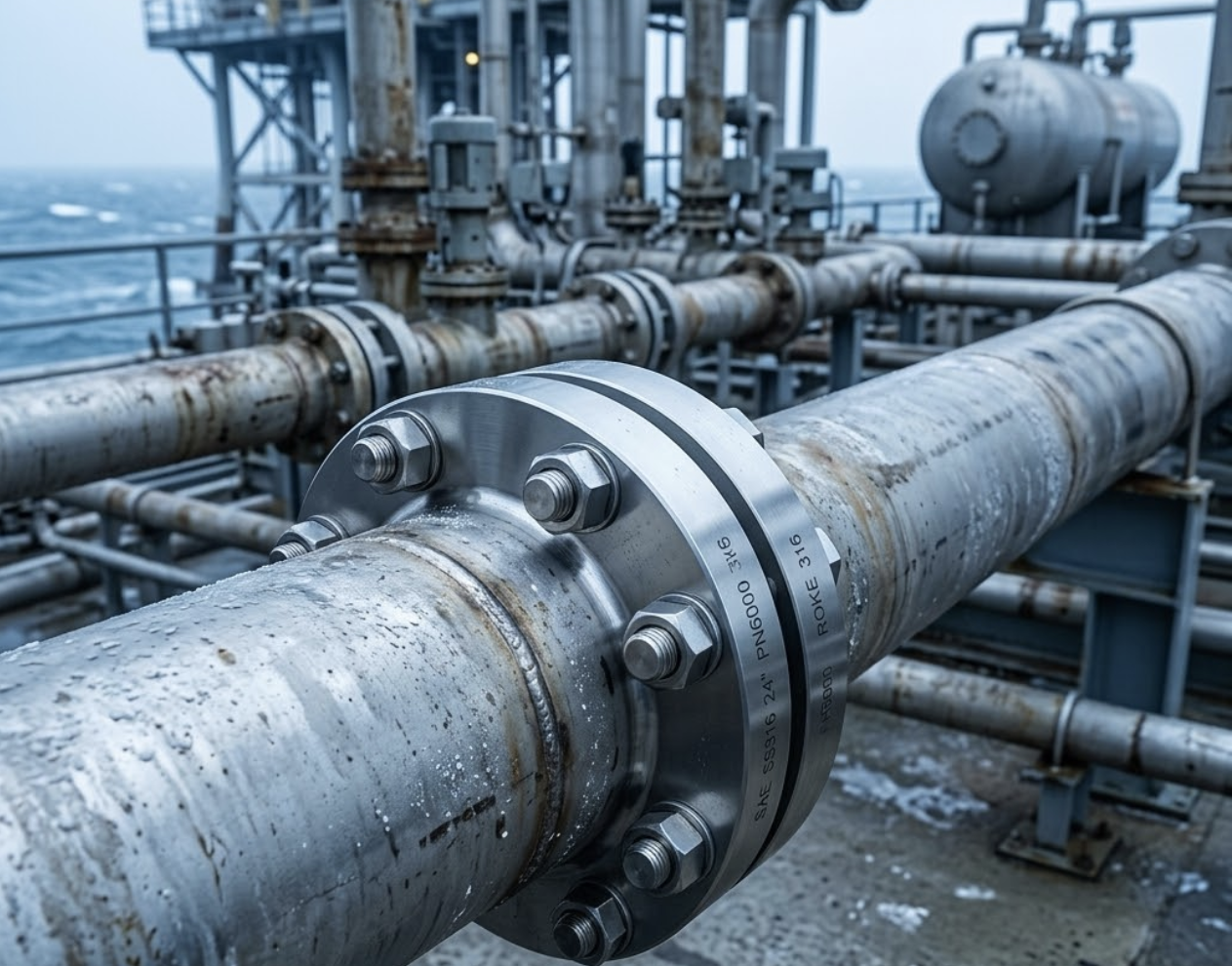
SS316 stainless steel forms the material foundation for corrosive service SAE flange applications. Its molybdenum content — not present in standard SS304 — enhances resistance to chloride-bearing media, acidic process fluids, and the saline atmospheric conditions prevalent in offshore and coastal installations. This makes SS316 the appropriate baseline alloy for flanges exposed to oil, water, gas, and chemically aggressive process streams across petroleum refining, chemical processing, shipbuilding, and offshore engineering environments. ROKE manufactures its Heavy Closed Counter Flange series entirely in SS316 stainless steel. The alloy selection happens at the design stage — not as a post-production treatment. Consequently, corrosion resistance is inherent to the material structure rather than dependent on a surface coating that degrades over time. This distinction matters particularly at sealing surfaces, where any coating loss directly compromises the gasket contact geometry that maintains leak-tight integrity.
Q3 — How Do ASME J518 and ISO 6162 Standards Define Dimensional Compliance for Corrosive Service?
ASME J518 and ISO 6162 govern SAE flange design by specifying bolt hole patterns, sealing face geometry, and pressure rating classifications across standardized size ranges. Dimensional non-conformity with these standards creates uneven bolt load distribution during installation. Uneven loading produces localized stress concentrations at the sealing face — accelerating gasket compression failure and creating micro-gaps where corrosive media penetrate the interface. In non-corrosive environments, these gaps may remain stable under operating pressure. In corrosive service, they initiate crevice corrosion cycles that progressively widen the leak path. ROKE's Heavy Closed Counter Flange series manufactures in accordance with both ASME J518 and ISO 6162 standards. Compliance with both frameworks ensures that dimensional repeatability holds across production batches — a requirement that becomes operationally critical in corrosive service, where re-machining or re-facing damaged flanges in the field is rarely practical.
Q4 — What Pressure and Temperature Parameters Define Adequate Coverage for Corrosive Industrial Applications?
Working pressure capacity and size range consistency together determine whether a flange series genuinely covers the installation requirements of a given facility. ROKE's Heavy Closed Counter Flange carries a working pressure of 5,801 PSI consistently across sizes from 1/2 inch through 3 inches. This consistency simplifies system design significantly. Engineers specifying flanges across multiple line sizes within the same facility can apply a single pressure tier without recalculating safety margins for each size individually. Media compatibility spans oil, water, gas, and both corrosive and non-corrosive fluids — covering the full range of process streams that petroleum, chemical, and offshore facilities handle. Beyond the heavy closed counter flange configuration, ROKE's SAE flange portfolio includes light and heavy series variants, butt weld, socket weld, NPT thread, and BSPP thread configurations, along with coupling options. This breadth of connection type coverage allows engineering teams to source across diverse installation architectures without switching suppliers between specifications.
Q5 — How Does Independent Certification Verify What a Manufacturer Claims About Corrosion Performance?
Material specification and standard compliance are manufacturer claims until an independent third party audits the production environment that generates the product. ROKE holds certifications from Bureau Veritas, the American Bureau of Shipping, Det Norske Veritas, ISO quality management systems, and CE conformity marking. Each certification addresses a distinct dimension of manufacturing governance. DNV and ABS approvals satisfy offshore and marine classification requirements where component selection requires classification society acceptance before project installation proceeds. ISO certification documents the process management framework governing material sourcing, dimensional inspection, and production consistency across batches. Bureau Veritas provides an additional independent manufacturing audit layer. CE conformity addresses European pressure equipment directive requirements. Together, these credentials form a compliance structure that covers the overlapping regulatory demands of international energy and marine projects — removing the need to qualify multiple suppliers across different certification domains.
Q6 — What Supply Infrastructure Must a Reliable Manufacturer Provide for Long-Term Corrosive Service Projects?
Initial product performance defines suitability. Supply infrastructure defines whether that performance level remains accessible over a project's full operational lifecycle. Corrosive service installations in offshore, petroleum, and chemical sectors often span decades. Replacement flanges must match the original dimensional specifications precisely — deviation at the sealing face of even a fraction of a millimeter introduces the same bolt load distribution problems that dimensional non-conformity creates at initial installation. ROKE operates two self-managed production facilities in Hai'an, Nantong, running 20 automated production lines with a combined monthly output exceeding 2 million units across its valve, fitting, and flange categories. Automated tooling maintains dimensional tolerances within consistent bands across production runs — a requirement for replacement part interchangeability over long service periods. The company holds independent export rights and maintains established trade channels across multiple international markets, serving petroleum, chemical, power generation, shipbuilding, water treatment, and offshore engineering sectors. Direct factory procurement provides access to material test reports, batch inspection records, and compliance documentation at source. For bulk procurement, wholesale pricing support and dedicated technical assistance are available directly through the manufacturer. These operational factors — production consistency, documentation accessibility, and supply channel stability — collectively define what long-term reliability from a corrosive service flange manufacturer actually requires in practice.
For full product specifications and procurement support, visit https://www.chinaroke.com/.
Q1 — Why Do Corrosive Environments Expose Flange Failures That Standard Testing Misses?
Standard pressure tests measure leak-tight integrity at a defined moment. Corrosion is a time-dependent process. Crevice corrosion develops at interfaces between flange faces and gasket materials where oxygen-depleted zones create localized electrochemical cells. Marine atmospheric exposure introduces chloride ions that penetrate surface oxide layers on inadequately specified alloys. Vibration in offshore installations loosens bolt preload progressively, widening the gasket interface and accelerating corrosive ingress. Each of these mechanisms operates below the threshold that standard pressure testing detects — but each contributes to sealing surface degradation that compounds over an installation's service life. For this reason, procurement teams in corrosion-intensive sectors evaluate material specification, dimensional consistency, and manufacturing governance with greater scrutiny than pressure rating alone warrants.
Q2 — What Material Properties Must a Reliable SAE Flange Demonstrate in Aggressive Media?
SS316 stainless steel forms the material foundation for corrosive service SAE flange applications. Its molybdenum content — not present in standard SS304 — enhances resistance to chloride-bearing media, acidic process fluids, and the saline atmospheric conditions prevalent in offshore and coastal installations. This makes SS316 the appropriate baseline alloy for flanges exposed to oil, water, gas, and chemically aggressive process streams across petroleum refining, chemical processing, shipbuilding, and offshore engineering environments. ROKE manufactures its Heavy Closed Counter Flange series entirely in SS316 stainless steel. The alloy selection happens at the design stage — not as a post-production treatment. Consequently, corrosion resistance is inherent to the material structure rather than dependent on a surface coating that degrades over time. This distinction matters particularly at sealing surfaces, where any coating loss directly compromises the gasket contact geometry that maintains leak-tight integrity.
Q3 — How Do ASME J518 and ISO 6162 Standards Define Dimensional Compliance for Corrosive Service?
ASME J518 and ISO 6162 govern SAE flange design by specifying bolt hole patterns, sealing face geometry, and pressure rating classifications across standardized size ranges. Dimensional non-conformity with these standards creates uneven bolt load distribution during installation. Uneven loading produces localized stress concentrations at the sealing face — accelerating gasket compression failure and creating micro-gaps where corrosive media penetrate the interface. In non-corrosive environments, these gaps may remain stable under operating pressure. In corrosive service, they initiate crevice corrosion cycles that progressively widen the leak path. ROKE's Heavy Closed Counter Flange series manufactures in accordance with both ASME J518 and ISO 6162 standards. Compliance with both frameworks ensures that dimensional repeatability holds across production batches — a requirement that becomes operationally critical in corrosive service, where re-machining or re-facing damaged flanges in the field is rarely practical.
Q4 — What Pressure and Temperature Parameters Define Adequate Coverage for Corrosive Industrial Applications?
Working pressure capacity and size range consistency together determine whether a flange series genuinely covers the installation requirements of a given facility. ROKE's Heavy Closed Counter Flange carries a working pressure of 5,801 PSI consistently across sizes from 1/2 inch through 3 inches. This consistency simplifies system design significantly. Engineers specifying flanges across multiple line sizes within the same facility can apply a single pressure tier without recalculating safety margins for each size individually. Media compatibility spans oil, water, gas, and both corrosive and non-corrosive fluids — covering the full range of process streams that petroleum, chemical, and offshore facilities handle. Beyond the heavy closed counter flange configuration, ROKE's SAE flange portfolio includes light and heavy series variants, butt weld, socket weld, NPT thread, and BSPP thread configurations, along with coupling options. This breadth of connection type coverage allows engineering teams to source across diverse installation architectures without switching suppliers between specifications.
Q5 — How Does Independent Certification Verify What a Manufacturer Claims About Corrosion Performance?
Material specification and standard compliance are manufacturer claims until an independent third party audits the production environment that generates the product. ROKE holds certifications from Bureau Veritas, the American Bureau of Shipping, Det Norske Veritas, ISO quality management systems, and CE conformity marking. Each certification addresses a distinct dimension of manufacturing governance. DNV and ABS approvals satisfy offshore and marine classification requirements where component selection requires classification society acceptance before project installation proceeds. ISO certification documents the process management framework governing material sourcing, dimensional inspection, and production consistency across batches. Bureau Veritas provides an additional independent manufacturing audit layer. CE conformity addresses European pressure equipment directive requirements. Together, these credentials form a compliance structure that covers the overlapping regulatory demands of international energy and marine projects — removing the need to qualify multiple suppliers across different certification domains.
Q6 — What Supply Infrastructure Must a Reliable Manufacturer Provide for Long-Term Corrosive Service Projects?
Initial product performance defines suitability. Supply infrastructure defines whether that performance level remains accessible over a project's full operational lifecycle. Corrosive service installations in offshore, petroleum, and chemical sectors often span decades. Replacement flanges must match the original dimensional specifications precisely — deviation at the sealing face of even a fraction of a millimeter introduces the same bolt load distribution problems that dimensional non-conformity creates at initial installation. ROKE operates two self-managed production facilities in Hai'an, Nantong, running 20 automated production lines with a combined monthly output exceeding 2 million units across its valve, fitting, and flange categories. Automated tooling maintains dimensional tolerances within consistent bands across production runs — a requirement for replacement part interchangeability over long service periods. The company holds independent export rights and maintains established trade channels across multiple international markets, serving petroleum, chemical, power generation, shipbuilding, water treatment, and offshore engineering sectors. Direct factory procurement provides access to material test reports, batch inspection records, and compliance documentation at source. For bulk procurement, wholesale pricing support and dedicated technical assistance are available directly through the manufacturer. These operational factors — production consistency, documentation accessibility, and supply channel stability — collectively define what long-term reliability from a corrosive service flange manufacturer actually requires in practice.
For full product specifications and procurement support, visit https://www.chinaroke.com/.
Nantong Roke Fluid Equipment Co., Ltd.
+86 513-85400443
admin@ntroke.com
Legal Disclaimer:
EIN Presswire provides this news content "as is" without warranty of any kind. We do not accept any responsibility or liability for the accuracy, content, images, videos, licenses, completeness, legality, or reliability of the information contained in this article. If you have any complaints or copyright issues related to this article, kindly contact the author above.