

National Cheng Kung University Unveils 'Tainan Chapter' with UN Experts Advance Indigenous Landscape Carbon Credit Model
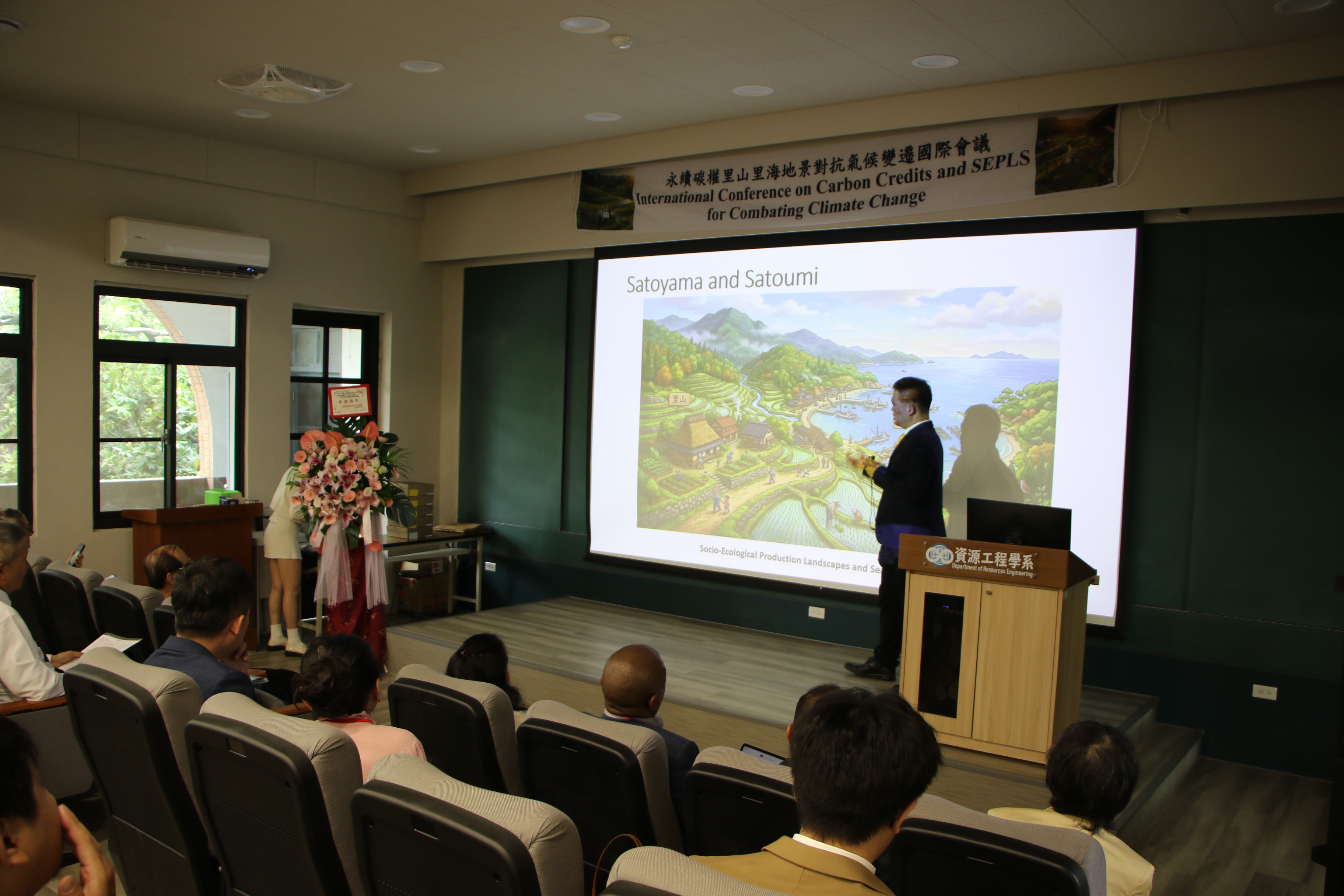
Prof. Yen-Hsun Su explain Satoyama Mace Initiative

Tainan Chapter as a potential international model for integrating carbon markets with community-based sustainability.
Tainan Chapter redefines carbon credits as community-based stewardship, aligning Taiwan model with global climate and biodiversity frameworks.
TAINAN, TAIWAN, April 15, 2026 /EINPresswire.com/ -- National Cheng Kung University (NCKU) hosted the International Conference on Carbon Credits and Socio-Ecological Production Landscapes and Seascapes (SEPLS) for Combating Climate Change on April 8–9, bringing together Taiwanese scholars and representatives from United Nations–affiliated organizations to launch the “Tainan Chapter,” a new framework aimed at redefining carbon credits through indigenous stewardship and community-based governance.
Participants from organizations including the U.N. climate change and the United Nations Development Programme (UNDP) traveled to Taiwan to support collaboration under the Satoyama Mace Initiative, culminating in the joint release of the Tainan Chapter. The declaration seeks to align Taiwan’s social development with the protection of indigenous and local community rights while connecting to international environmental policy, highlighting Taiwan’s growing role in global net-zero efforts.
Professor Jyh-Ming Ting, conference chair professor at NCKU, described the Tainan Chapter as a voluntary global framework designed to transform carbon credits and SEPLS conservation into a high-integrity economic system. He said the initiative reflects a strong international perspective and responds to both the Kunming-Montreal Global Biodiversity Framework (KMGBF) and the Global Goal on Adaptation under the U.N. climate agenda.
At its core, the framework integrates Taiwan’s unique geography—from ocean to high mountains—into what Ting called a “vertical wetland” resilience model, translating abstract climate policy into practical implementation.
The declaration promotes a shift from viewing carbon credits as emission allowances to treating them as “reciprocal stewardship contracts.” It introduces the concept of a “bio-cultural dividend,” arguing that the long-term stability of carbon systems depends on the socio-economic well-being of communities. Under this model, carbon credits evolve from transactional instruments into mechanisms that support cultural preservation and environmental stewardship, aligning with global principles of social equity and justice.
The Tainan Chapter outlines four key strategies: aligning with international environmental policies through collaboration with U.N.-related organizations; contributing to countries’ Nationally Determined Contributions (NDC 3.0) through partnerships with local governments worldwide; ensuring carbon market revenues flow back to indigenous peoples and local communities; and integrating artificial intelligence and satellite observation technologies to scale Taiwan’s experience globally.
Professor Yen-Hsun Su, an executive committee member of the conference, emphasized that the Satoyama Mace Initiative serves as the operational platform of the framework. He said it ensures indigenous peoples and communities are not just beneficiaries but co-creators of ecological value.
“The Tainan Chapter represents a paradigm shift,” Su said. “Carbon credits are no longer simply emission permits—they become reciprocal agreements for landscape stewardship. Taiwan’s model provides a scalable blueprint for global regeneration.”
The initiative incorporates the principle of Free, Prior and Informed Consent (FPIC) and aims to digitally integrate traditional ecological knowledge (TEK) with advanced technologies, addressing long-standing challenges of trust and transparency in nature-based carbon markets.
Dr. Amit Sharma, a member of the International Union for Conservation of Nature (IUCN), said Taiwan’s strength extends beyond its technological sector.
“Taiwan’s real potential lies not only in semiconductors, but in its vertically integrated ecosystems—from oceans to mountains,” Sharma said. “Through the Tainan Chapter, Taiwan is demonstrating leadership in global net-zero transitions.”
The conference was convened with endorsement from the International Partnership for the Satoyama Initiative (IPSI) under the United Nations University Institute for the Advanced Study of Sustainability (UNU-IAS). It brought together IPSI members, academics, policymakers, local communities and stakeholders in carbon credit mechanisms to co-develop solutions that advance both climate goals and resilient socio-ecological systems.
Among the speakers, Motsomi Maletjane, a representative of the U.N. climate change, shared insights on global resilience strategies. Manuel Mavila, national coordinator of the UNDP Small Grants Programme, presented community-based resilience practices from Peru. Professor Maiko Nishi discussed interconnected climate and biodiversity challenges in SEPLS, while Dr. Pradeep Mehta of UNDP highlighted opportunities in Himalayan indigenous food systems, ecosystem service payments and carbon credits.
Taiwanese researchers also contributed key innovations. Academician Chiu-Chung Yang of Academia Sinica presented enzyme-based technologies for soil carbon sequestration, while experts from the Taiwan Space Agency (TASA) demonstrated how satellite imagery from the FORMOSAT-8 program can enhance precision monitoring of ecological change.
Organizers said the conference strengthened Taiwan’s participation in global climate governance and positioned the Tainan Chapter as a potential international model for integrating carbon markets with community-based sustainability.
The Tainan Chapter & Global Indigenous Partnership
A Vision for High-Integrity Nature Markets and Socio-Ecological Resilience
I. The Tainan Chapter: A Global Framework for SEPLS, Carbon, and Nature Markets
The Tainan Chapter is a voluntary, non-binding global framework dedicated to advancing integrated solutions for climate change mitigation, biodiversity conservation, and the enhancement of sustainable livelihoods.
By championing the revitalization of Socio-Ecological Production Landscapes and Seascapes (SEPLS), the Initiative seeks to transform traditional stewardship into scalable, high-integrity systems that bridge the gap between ecological health and global nature markets. Aligned with the Kunming-Montreal Global Biodiversity Framework and the UNFCCC Global Goal on Adaptation, the Initiative promotes a system-based approach through four strategic pillars:
Methodological Rigor: Advancing precise carbon accounting and ecological monitoring.
Policy Alignment: Harmonizing local actions with international climate frameworks.
Community Governance: Strengthening decentralized, inclusive decision-making structures.
Market Connectivity: Catalyzing access to green finance and transparent nature markets.
Strategic Outcomes:
The Tainan Chapter facilitates measurable impacts in Climate Adaptation, Biodiversity Restoration, and Community-led Economic Prosperity. Participation is open to all stakeholders—governments, international organizations, research institutions, and the private sector—serving as a collaborative platform for innovation without implying formal institutional endorsement.
II. Global Indigenous Partnership: Ensuring Inclusive, Rights-Based, and Community-Led Action
Central to the Tainan Chapter is Global Indigenous Partnership, a dedicated mechanism ensuring that Indigenous Peoples and Local Communities (IPLCs) remain at the forefront of the global climate agenda. Grounding every action in the principle of Free, Prior and Informed Consent (FPIC), the Partnership recognizes Indigenous Peoples not merely as beneficiaries, but as the primary architects and stewards of resilient landscapes.
The Partnership Facilitates:
Synergetic Knowledge Exchange: Integrating Traditional Ecological Knowledge (TEK) with cutting-edge scientific methodologies.
Capacity Empowerment: Providing technical tools for baseline assessments and monitoring.
Equitable Market Access: Ensuring that carbon and nature revenues flow directly back to community stewardship.
Sovereign Stewardship: Upholding traditional land governance and cultural integrity.
By placing IPLCs at the center of the value chain, the Partnership ensures that environmental actions are socially just, culturally appropriate, and ecologically sustainable.
III. Implementation Mechanism: Operationalizing Vision through the Satoyama Mace Initiative (SMI)
The Satoyama Mace Initiative (SMI) serves as the primary operational platform for the Tainan Chapter. It translates high-level principles into concrete, on-the-ground actions through:
Project Incubation: Developing nature-based carbon projects in diverse SEPLS.
Technical Services: Deploying AI-driven and satellite-based MRV (Measurement, Reporting, and Verification).
Market Bridge: Facilitating the listing and trading of community-led credits on international platforms (e.g., ACX, CIX).
The SMI’s Global Indigenous Partnership Invitation remains the core pathway for communities to access these resources, ensuring that global climate finance effectively supports local ecological guardians.
IV. Why Taiwan and The Tainan Chapter?
The Tainan Chapter offers a decisive early mover advantage for implementing strategic goals of the KMGBF and UNFCCC. Over the years, The Taiwan Model has proved to be a resilient and vibrant force for tackling the impacts of climate change.
Being a vertical wetland, with ecosystems spanning from the seas to high mountains, active participation of the local communities is the foundation of harmonious coexistence with nature. This geography has taught us a vital truth about SEPLS management: a carbon sink is only as strong as the socio-economic health of the neighboring village. It is this realization that The SMI’s Global Indigenous Partnership is advocating for a bio-cultural dividend, where the survival of a specific cultural practice is the primary driver of carbon stability.
The Tainan Chapter is moving beyond agreements on paper to shared steps in a Direction. The evolution of carbon credits from “license to emit” into “a contract of reciprocity” within our landscapes is pivotal. Realizing this shift requires an alignment of mindsets and a coalition of partners recognizing that local stewardship and global stability are inseparable. By bringing collective wisdom to this common goal, the progress made today establishes the standard for the landscapes of tomorrow.
The Taiwan Model and The Tainan Chapter is a scalable blueprint for other regions of the world seeking to meet KMGBF and UN sustainability goals through SEPLS management. It is a transition from passive observation to the deliberate construction of a regenerative future.
Drafted by Dr. Amit Kumar Sharma and Prof. Yen-Hsun Su
Presented and Discussed by the Conference Delegates on April 8, 2026.
Yen-Hsun Su
SEPLS Carbon Credit Regional Revitalization Center
email us here
Legal Disclaimer:
EIN Presswire provides this news content "as is" without warranty of any kind. We do not accept any responsibility or liability for the accuracy, content, images, videos, licenses, completeness, legality, or reliability of the information contained in this article. If you have any complaints or copyright issues related to this article, kindly contact the author above.
