

Lithotripsy Devices Market Size to Hit US$ 2.8 Bn by 2033, Says Persistence Market Research
lithotripsy devices market
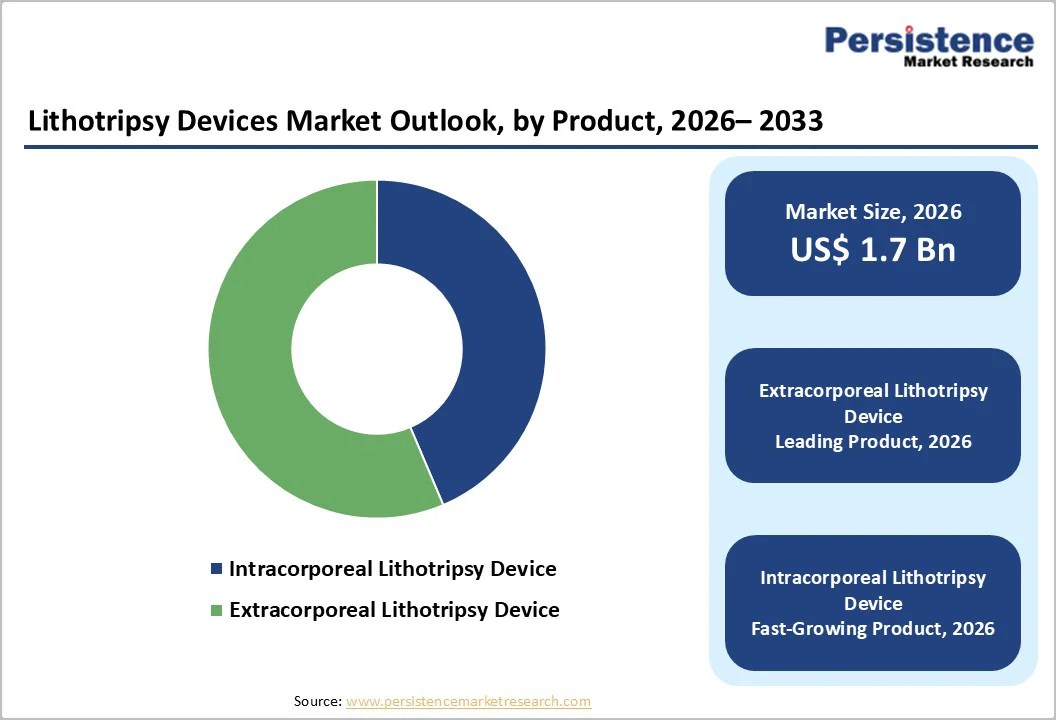
LONDON, UNITED KINGDOM, February 9, 2026 /EINPresswire.com/ -- The global lithotripsy devices market is projected to grow significantly, with an estimated market size of US$ 1.7 billion in 2026, reaching US$ 2.8 billion by 2033. The market is expected to record a CAGR of 5.2% from 2026 to 2033. This growth is driven by the rising prevalence of kidney stones and peripheral artery disease (PAD), increasing preference for minimally invasive procedures, and expansion of outpatient and ambulatory care facilities. The adoption of advanced intravascular and extracorporeal lithotripsy technologies is also boosting market demand.
Download Your Free Sample & Explore Key Insights: https://www.persistencemarketresearch.com/samples/23587
Key Industry Highlights
North America dominates the lithotripsy devices market with a 43.4% share due to high kidney stone prevalence, advanced healthcare infrastructure, strong adoption of IVL and extracorporeal lithotripsy systems, and favorable reimbursement policies. Asia Pacific is the fastest-growing region, fueled by increasing kidney stone incidence, expanding access to outpatient care, rapid healthcare digitization, and rising adoption of portable and catheter-based devices. Extracorporeal lithotripsy devices lead the product segment due to non-invasive application, precision, and safety, while intravascular lithotripsy (IVL) devices are the fastest-growing segment owing to affordability and minimally invasive benefits. Kidney stones dominate the application segment, whereas ureteral stones are the fastest-growing category due to rising prevalence and patient preference for outpatient treatments.
Market Dynamics
Driver – Rising Nephrolithiasis Burden and Technological Advancements
The increasing incidence of nephrolithiasis, driven by aging populations, obesity, dehydration, and dietary habits, is pushing healthcare providers to adopt faster, minimally invasive stone-management techniques. According to the National Kidney Foundation, kidney stones account for over 500,000 emergency room visits annually in the U.S., with roughly one in ten individuals affected in their lifetime. Advancements such as portable extracorporeal shock wave lithotripsy (ESWL) units, improved shock-wave targeting, high-resolution imaging, and energy-efficient generators are enhancing procedural safety and accessibility.
Restraints – Cost and Clinical Limitations
High upfront costs, variable reimbursement, and notable per-procedure expenses restrict adoption in smaller hospitals and ambulatory centers. Clinical limitations, such as reduced effectiveness for large or lower-pole stones and contraindications in certain patient populations, also limit use. Competitive procedures like ureteroscopy and percutaneous nephrolithotomy, which provide higher stone-free rates for complex cases, alongside improved medical expulsive therapies, pose additional challenges.
Opportunity – Smart Imaging Integration and Portable Devices
AI-driven imaging, real-time stone tracking, and automated targeting are enhancing treatment precision and workflow efficiency. Hybrid therapies combining ESWL with laser or ultrasound modalities allow treatment of complex stones with fewer complications. Development of portable, cost-effective lithotripsy units expands access in ambulatory surgical centers and smaller facilities, enabling higher procedure throughput and penetration into resource-constrained settings.
Get Custom Insights Designed for Your Business: https://www.persistencemarketresearch.com/request-customization/23587
Category-wise Analysis
By Product Insights
Extracorporeal lithotripsy devices dominate the market with a 56.4% revenue share in 2026 due to non-invasive treatment, shorter recovery, and widespread use in kidney and ureteral stone management. Advancements in shock-wave targeting and imaging integration further support growth.
By Modality Insights
Standalone devices hold a 54.7% share in 2026, favored for high energy output, integrated imaging, and superior efficiency across stone types. Their durability and compatibility with advanced targeting technologies make them ideal for high-volume hospitals and specialized urology centers.
By End-user Insights
Hospitals account for a 56.9% revenue share in 2026, benefiting from advanced imaging systems, higher patient inflow, and capacity to handle complex cases. Capital budgets enable investments in standalone ESWL systems, hybrid technologies, and integrated urology suites.
Region-wise Insights
North America dominates with 43.4% market share, led by the U.S., supported by high kidney stone incidence, advanced healthcare infrastructure, and favorable reimbursement mechanisms. Adoption of AI-integrated imaging and high-power lasers accelerates modernization.
Europe shows steady growth driven by aging populations, lifestyle-related risk factors, and strong adoption of minimally invasive procedures. Investments in ESWL platforms and outpatient procedures contribute to expansion.
Asia Pacific is the fastest-growing region with a projected CAGR of 7.8% due to rising kidney stone prevalence, urbanization, lifestyle changes, obesity, diabetes, and improved healthcare infrastructure. Private hospital expansion, medical tourism, and portable device availability further accelerate adoption.
Competitive Landscape
The market is highly competitive, with key players including Siemens Healthineers AG, Dornier MedTech, Boston Scientific Corporation, STORZ MEDICAL AG, İnceler Medikal Ltd., DirexGroup, Johnson & Johnson, Focal One, GEMSS Healthcare, Olympus Corporation, Cook Group, EMS, Allengers, and Potent Medical. Companies are focusing on compact, portable, and digitally enhanced systems integrating AI-driven imaging, real-time stone tracking, automated targeting, and hybrid energy solutions. Strategic initiatives include mergers, acquisitions, partnerships with urology centers, and expansion into high-growth regions such as Asia Pacific and the Middle East.
Checkout Now & Download Complete Market Report: https://www.persistencemarketresearch.com/checkout/23587
Market Segmentation
By Product
Intracorporeal Lithotripsy Device
Extracorporeal Lithotripsy Device
By Modality
Standalone Device
Portable Device
By Application
Kidney Stones
Ureteral Stones
Bladder Stones
Pancreatic Stones
Others
By End-user
Hospitals
Specialty Clinics
Ambulatory Surgery Centers
By Region
North America
Europe
East Asia
South Asia and Oceania
Latin America
Middle East and Africa
Recent Industry Developments
In 2025, Johnson & Johnson launched the Shockwave Javelin Peripheral IVL Catheter in Europe for PAD treatment. Avvio Medical’s enhanced lithotripsy system (ELS) received FDA Breakthrough Device Designation for ureteral stones. Shockwave Medical introduced the U.S. launch of the Shockwave Javelin Peripheral IVL Catheter, while Philips began the THOR IDE clinical trial for a combined laser atherectomy and IVL catheter.
The global lithotripsy devices market continues to expand, driven by technological innovation, rising disease prevalence, and increasing preference for minimally invasive procedures, offering significant growth opportunities across regions, product segments, and clinical applications.
Read Related Reports:
Western Blotting Market: Global western blotting market to reach US$2.8 Bn by 2032, driven by advances in proteomics, molecular biology research, and rising diagnostic applications.
Chromatographic Separation Resins Market: Global chromatographic separation resins market to reach US$2.4 Bn in 2025 and US$4.3 Bn by 2032, growing at a strong CAGR of 8.7% during 2025–2032.
Persistence Market Research
Persistence Market Research Pvt Ltd
+1 646-878-6329
email us here
Visit us on social media:
LinkedIn
Instagram
Facebook
YouTube
X
Legal Disclaimer:
EIN Presswire provides this news content "as is" without warranty of any kind. We do not accept any responsibility or liability for the accuracy, content, images, videos, licenses, completeness, legality, or reliability of the information contained in this article. If you have any complaints or copyright issues related to this article, kindly contact the author above.
